This was one of those films where, while I was fascinated by the concept, I never felt any desire to watch it. With it being July, I felt it would be fitting. In that spirit, I sat down and watched every movie and even the TV series. In case anyone wants to get into this, there will be spoilers.
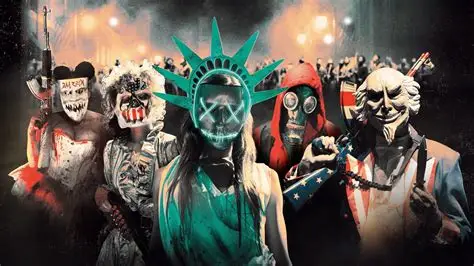
Also, for those unfamiliar with The Purge, it revolves around an alternate America that has made all crime legal (with the exception of harming politicians) for 12 hours one night of the year. Right off the bat, I would be lying if I said I thought this franchise was good. Sure, it has clever commentary. The issue is it gets bogged down by kind of generic storytelling. It seems every installment has the over-the-top crazy person and the hero who rescues them at the last minute.
Why am I talking about these films then? Despite my misgivings, I did find them entertaining, and for their faults, the broader picture they painted was unsettling. I think The Purge is one of those stories where the films are better if you look at all the movies as a whole instead of individually analyzing each installment. The order in which you view them also matters. I watched them chronologically instead of by date.
For transparency, I didn’t go into them entirely ignorant since I have seen the Nostalgia Critic’s Purge videos. Thanks to him, I knew the twist of those films going into them. Shocker, The Purge doesn’t work. In short, the government uses it as a means of forced population reduction via mercenaries. While I was aware of this, what I didn’t know was that the NFFA (New Founding Fathers Of America – A Party that usurped the Democrats and Republicans during massive unrest) had been doing this since the very beginning.
That’s right. The First movie (chronologically) pretty much states this outright. When they test The Purge on Staten Island, they realize most of the crimes being committed are either petty or for financial gain. To remedy this, they utilize hired guns to give the appearance their “social experiment” worked. Thus, giving them justification to expand it to all of the U.S. Outside of the obvious “killing bad!” lesson, this also demonstrates how much people in power are willing to manipulate things to achieve their desired result.
What makes it worse is The Purge is presented as an outlet for brutality. They even have behavior scientists concurring this by telling everyone humans are inherently violent, so it makes sense to have a holiday where all that primal aggression can be unleashed. Here’s the problem, and that is this isn’t true for the majority of people. We’re destructive as hell. There’s no denying that. However, your average person isn’t going around wanting to waste a bunch of people.
Maybe they want to give their shitty boss a black eye or slash the tires of someone who cuts them off but that’s as far as the majority are likely willing to go. Most people want to thrive or at least get by. The NFFA is aware of this, and that’s why there’s a ton of gaslighting. It isn’t only the adults, either.
One of the most disturbing scenes to me came from the TV series. It’s a segment that presents a Purge children’s program similar to something that PBS would air. This means the NFFA is using money (likely tax dollars) to make sure even kids are conditioned to accept The Purge. The results of this are shown with one character (who I can’t name because again, generic psycho), where there’s a flashback of him watching it when he was little. When he hears the lady hosting say The Purge is good, he is seen breaking his toys, demonstrating his first signs of aggression.
Whether or not his psychotic tendencies resulted from the show or were already present doesn’t matter. The point is The Purge and by extension, The NFFA, is normalizing violence. Again, this is shown in the TV series where it’s stated The Purge is actually increasing hostility rather than being an outlet for it. After all, what is the point of civilly settling differences when people can wait until a certain day that will allow them to get even? Thus, they become further divided.
Relating to this, The Purge is a political series, so it’s always going to have relevancy, but for my first time watching these films, specifically now with everything going on, added an extra layer of eeriness to it. Don’t get it twisted. I don’t want to give the impression that I think we’re a stone’s throw away from it becoming a reality. If this administration announces they are considering trying to see what would happen if they tried suspending laws in a major city, then I think we should be legitimately concerned. As things stand, we hopefully have a ways to go before getting to this point.
Steps need to be taken to remove the normalizing of violence. Society has always been more accepting of it. Even on local TV, it’s like, “We can air Peter on Family Guy running over a bunch of people, but if a drawing of a woman’s nipple is shown, it has to be censored!”. What message is this supposed to send other than that which ends life is more noble than that which creates it? Two things I blame on this, religion and prude culture in general.
I get that an aversion to sexuality may stem from bad experiences. For the people for whom this is the case, a perfectly valid response. I have no qualms with you. Do what’s best for your own well-being. My issue comes from people who haven’t had anything of the sort happen to them. All they want is for everyone else to be forced to conduct themselves in a way they see fit. Oftentimes, they rarely hold themselves to the same standard.
Reflexive hypocrisy makes the world go around, apparently. I’m not exempting myself. It’s a matter of varying degrees. What is the difference between normalizing something and providing an outlet for it? The former means a thing is acceptable in everyday life.
The latter is something through which certain feelings can be channeled. As an example, the assumption that savagery in fiction results in it happening in real life still persists despite almost no evidence. Sure, there may be sensationalized incidents where someone who did something horrible was into GTA or something, but there’s always underlying mental illness (not that all people who have them are ticking time bombs, just to be clear). Those who are well adjusted don’t get the urge to waste a bunch of people, regardless of the media they consume. I’m not saying what people choose to absorb has zero impact. From what I have skimmed, there’s no definitive answer to whether or not aggression in the media causes it in those who are fans of it.
You can argue that this sort of thing can be an outlet for darker urges. Personally, I think entertainment in general is an outlet, and whether or not it’s graphic doesn’t make a difference. People having the time to sit down and enjoy the things they love is what keeps all hell from breaking loose. It is the lightning rod.
The Purge (and apologies for the tangent) is the antithesis of this. Instead of the NFFA taking steps to improve lives, they go out of their way to take them. Although it may seem to make things better superficially, it’s all an act. The well off see it as working, while the downtrodden saw through it from the start. It’s not exactly fair when one person can afford to arm themselves the other three hundred and sixty-four days of the year.
Meanwhile, others have to make due and hope it’s enough. That’s just talking about situations where people are kind of on equal economic footing. It’s even worse when it comes to the poor vs the rich in these movies because the wealthy have something a lot of people are lacking, resources. If they were using them solely for protection, it would be understandable. Instead, they utilize them to direct their own sadism toward those they deem beneath them.
It’s so bad in those movies, they pay to get the poor or prisoners and either kill them on the spot or hunt them for sport. To make it even more fucked up, people can even offer themselves up in exchange for their families getting a large sum of money. The desperation this conveys is staggering. Wow, I prefaced this article by saying I didn’t think this series was good. Now here I am going all analytical about the messaging and what it should convey.
While I stand by my criticisms, I will say it is thought-provoking. I wonder what exactly the NFFA’s end goal was? I know The Purge was meant for population control, but at a certain point, it’s going to diminish too much. Were they planning on eventually revoking it? In any case, this ends up happening anyway, and the consequences were not good.
This is highlighted in The Forever Purge. At this point, The Purge has evolved from a law into a tradition. When something has become rooted in culture, it becomes almost impossible to get rid of, no matter how detrimental. With The Purge, this results in full-on civil war. I do have a bit of a nitpick here. The other films gave the impression that The Purge was declining in popularity.
President Charlie is implied to have won the election pretty handily. Therefore, it doesn’t make a lot of sense to me that there would be enough people still supporting to hold their own against the government. This aside, what this shows is a recurring problem in history. Those who are the cause of or who continue to perpetuate an issue seldom face punishment for it. Unless humanity changes fundamentally, this will perpetuate. A neglected tire can only travel so much before it pops, and then comes the crash.
I don’t want to conclude on too harrowing a note, though, so let’s get into the more technical aspects of this franchise. I don’t normally do things like “This is what I would do differently!” Because I get there was a certain vision in mind, and the in-your-face stuff is the intent. With that said, I think this series would be a lot more effective with a more minimal style of storytelling. The first film kind of does this, where they show found footage of people committing crimes. It made me wonder why they didn’t make an entire movie from that perspective.
Say the first film was depicted entirely this way. It opens with the dad character driving. Here, you can have a dash cam that picks up on what’s said on the radio. Then, when he enters the home, you switch to the security cameras. I think it would make things scarier by adding a layer of realism.
Imagine knowing nothing about what The Purge is, outside of the parents explaining it vaguely to their kids because they don’t want to fully expose them to it. Then, when it starts, you see POV footage of The Purgers in masks. What would you think they were, some kind of cult? Well, they wouldn’t be far off. As the film goes on and things get more dire for the family, more information about The Purge is revealed.
Remember, the parents supported The Purge up until this point. They’re having to explain to their youngest child what it is while simultaneously realizing how horrible it truly is. Other than this, the events would play out pretty much the same. Another thing they touched on, I wish they expanded on, happens in the TV series. Miguel, one of the few characters who stuck with me, is trying to save his sister from a murder cult on Purge Night.
In pursuit of his goal, he gets a ride from two guys. I don’t remember if one of them was from the UK or both. Either way, they’re filming The Purge to show it over there and prevent them from doing the same thing. Again, I would enjoy a movie entirely from this perspective. Comedy is another thing I feel is underutilized. Some people will be out for blood over the most trivial shit.
It will be something like, “You took the last pudding cup in eighth grade. Now, I’m taking your life!”. I could keep going, but I want to wrap things up. Comedy is another element I feel is underutilized in this franchise. On that note, here’s what I came up with:
The Purge: Waffle House
The Purge: Raid On Walmart
The Purge: Andy Dick
The Purge: Florida Man
If they decide to make a new one, pitch them these titles. Before we go, I want to say I hope you all reading this have a happy fourth. I know celebrating may seem counterintuitive given what’s been going on and it sucks people simply trying to live their lives have to deal with the shit they keep getting. Also, those making things difficult for them need to crawl back into their holes and fuck off forever. If you would allow me some sappiness, Independence Day should not be about the land or the flag.
Rather, it should be about those who give our nation meaning, those who bring culture and diversity, no matter how they came to be here. This is the way I’m choosing to celebrate, and I suggest you do the same. Once again, I hope you have a good one and happy reading.
If you want to support me, check out my Reddit’s pinned posts linked here (one of them has my tipping links) or join the writing Patreon I am a part of linked here where we post horror stories. Thanks, and happy reading.