
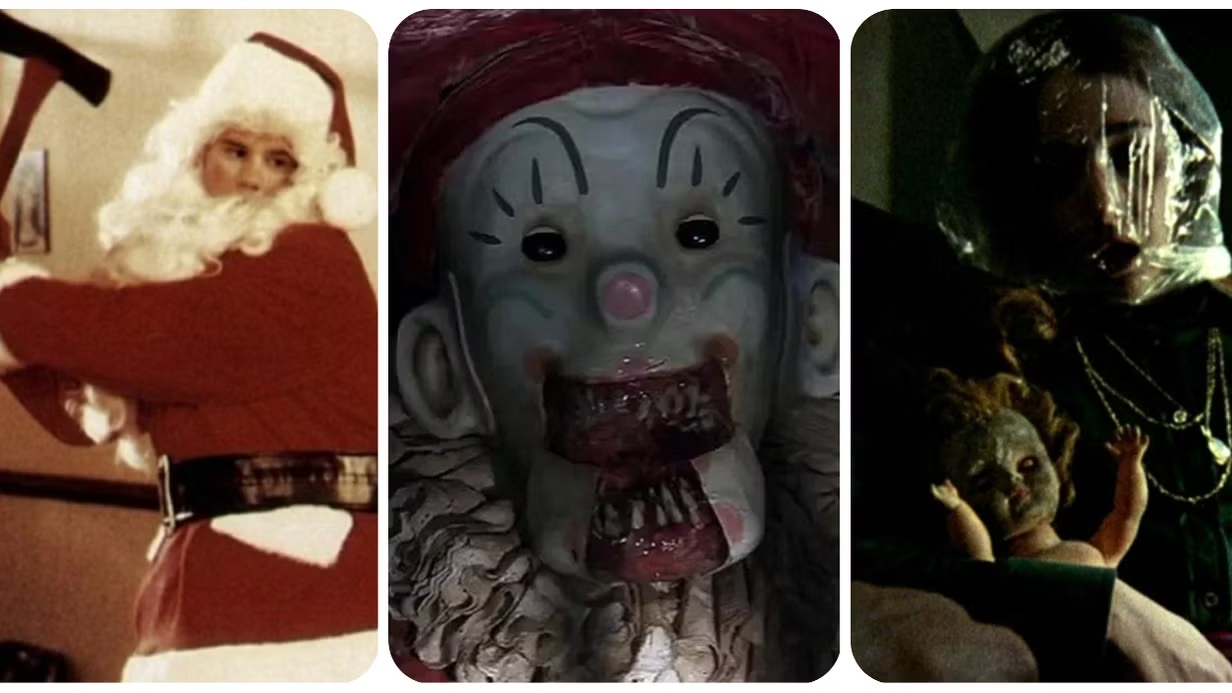
It’s that time. As is custom, I have to post my yearly Christmas-related article for the season. Actually, this one is going to be focusing on the Yule, because I want to get this out by the Solstice. I do have a topic, but this is going to be pretty free-form. I wanted to discuss the relationship between horror and this time of year.
This isn’t going to be a history lesson beyond the cursory, since there’s already stuff out there explaining how the custom originated (Though I will probably be doing some cursory research as I write this). Instead, I want to discuss how holiday horror has evolved and why it came to be in the first place. I think a good place to begin is with fairy tales. Anyone who’s read Grimm knows that the Disney adaptations are extremely toned down from the original stories. I’m not going to guess author intent, since that would be presumptuous.
It was clear that, in addition to instilling a sense of wonder in children, most of these tales were also meant to be cautionary. Red Riding Hood would be the most famous example, being a metaphor for stranger danger. By the way, I said most for the reason that some of the stories, I couldn’t figure out the moral. What exactly is the lesson in Hansel and Gretel? If a witch wants to eat you, try using fire?
Maybe it’s “Don’t be an assole or an idiot,” which is probably a good thing to be teaching kids, especially nowadays. I think we judge these kinds of tales too harshly. I hear child sensitivity wasn’t really a thing back then. I don’t think this is entirely true. While these fables may seem like straight-up horror to our modern sensibilities, we should keep in mind that things were harsher back then.
Without things such as electricity or modern medicine, it was difficult to navigate life on your own, let alone with a family to think about. You didn’t want your children wandering into the woods and getting eaten or lost. Therefore, you’d try deterring them with these stories.
In fact, I think their existence in the first place shows that, to a degree, society was keeping how children felt in mind. Otherwise, books like A Christmas Carol wouldn’t have resonated with so many when it was first published.
Not to mention, as someone who grew up a horror fiend, I have to imagine a lot of children enjoyed those stories. I think the inherent defiance present in humanity is responsible for this. Some people hear a story about someone getting eaten by a troll and don’t think, “I should stay out of those situations”. They think, “I’d be the one to overcome the threat. I’d be the one who’s smarter”.
Of course, that’s easier said than done. Just ask any kid whose tried to catch Santa coming down their chimney on Christmas Eve. He shows up for those who have been good. Those who haven’t receive visiors who are less welcome, beings such as Krampus, beating naughty kids and then taking them to spend a year in hell, or Frau Perchta (had to search her name), straight up disemboweling them. It just goes to show that sometimes coal isn’t enough. I put figures such as them, the yule cat, and the yule lads, among others, in the same category as early fairy tales.
It’s not surprising since horror and the holidays have been a long-standing custom. While on the topic, I do distinguish between customs and traditions. Customs are cultural, meant to be passed down and shared with those willing to participate. Traditions are for maintaining hierarchy, which is why deviation from them is often met with scrutiny or worse. Back on topic, it’s intriguing to think about how this season came to be associated with horror.
It’s easy to assume that it started with films like Black Christmas or Silent Night Deadly Night (I’ve heard good things about the new one), or even stories such as A Christmas Carol, stemming from the practice of telling ghost stories for the holidays during the Victorian era. However, the origins go further back, to the early Pagans. I read somewhere that they’d tell tales of terror around a Yule fire as part of the solstice celebration and that they did this to bring luck throughout the rest of the season. It could be seen as a ritual of sorts.
It makes sense, too, because the purpose of Yule or Saturnalia or things of that nature was for survival. Why else would they be set around the longest night of the year? It was a reprieve before having to face several months of bleak cold. I guess you could think of them as enchantments of sorts. I know I always feel down after the holidays are over.
Even though I prefer cold weather over hot, it’s still depressing seeing all the decorations have been taken down (aside from that one neighbor who leaves them up until February or keeps them up yearly), but at least if I want food, I can go to the store. I don’t have to go out hunting and possibly get killed in the process. Also, I don’t have to spend hours chopping wood, so I have a heat source to cook with. I should mention that I’m not trying to play the “things could always be worse, so be grateful!” card because it’s condescending and counterproductive to actually making things better. I’m just saying, if I were somehow transported to the era before all of today’s creature comforts, that shit would sucks ass.
Do you see how these celebrations began as a means of survival? I think that includes the horror aspect of them as well. Think about the scariest film you’ve ever seen by yourself, especially if you watched it at home and not at the theater. How did you feel right after? I bet you got the sense someone was in the room with you, even though you knew logically this was highly unlikely.
This stems from our evolutionary instincts. That feeling is you subconsciously raising your guard. Now, imagine you’re living way back then, and it’s the solstice. You’re seated around the Yule fire with your family, taking turns to tell the most terrifying tales you’ve ever heard. With each one, your heart beats a little faster. Eventually, the time comes for everyone to head back inside.
The fire is left to be reduced to embers by the falling snow. You can’t shake the idea that something is watching you from the woods. Fortunately, you have the comfort of knowing that these rituals your family has performed will give you the protection you need to face down the bitter chilliness and whatever cold creatures lurk in the dark until the flowers start blooming. Until then, enjoy the festivities as much as you are able. I prefer to do so with a good scare while on a nighttime stroll, even when the temperature is freezing.
The spirit of the season stems from resilience after all. I hope this one has been treating you well so far and will continue to do so. I also hope you enjoy what I’ll be posting in the new year. Happy horror days, everyone.

